Roquefort Cheese
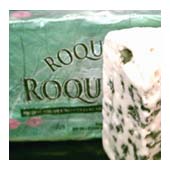
Roquefort cheese is made from ewe's-milk and comes from the south of France.
ie 'Roquefort-sur-Soulzon'.
The Aveyron region of France.
It is made entirely from the milk of the Lacaune, Manech and Basco-Béarnaise breeds of sheep.
Together with Bleu d'Auvergne, Stilton and Gorgonzola,
Roquefort Cheese is rated as one of the world's greatest blue cheeses.
The law in Europe says that only the cheeses aged in the natural Combalou caves of Roquefort-sur-Soulzon may bear the name 'Roquefort'.
Roquefort is sometimes known as the "King of Cheeses". To deserve this title, it should be
white, crumbly and moist in the centre and therefore easily spreadable. If it's a bit hard still, it can ripen in the fridge.
Roquefort Cheese has distinctive veins of blue mold, these blue veins provide a sharp tang.
When you eat roquefort there is a flavour sensation that begins
slightly mild, then sweet, then smoky, then fading to a salty finish.
Roquefort Cheese has no rind therefore the whole Roquefort is edible. As each kilogram of finished cheese requires about 4.5 litres of milk, Roquefort is high in fat, protein and minerals.
The story behind the cheese is, the cheese was discovered when a young shepherd, eating his lunch of bread and
ewes' milk cheese, saw a beautiful girl in the distance. Abandoning his meal in a nearby cave, he ran to meet her.
When he returned a few months later, the (Penicillium roqueforti) mold had transformed his plain cheese into Roquefort.
The mold that gives Roquefort its distinctive character (Penicillium roqueforti) is found in the soil of these famous caves.
Traditionally the cheesemakers extracted it by leaving bread in the caves for six to eight weeks until it was consumed by the mold. The interior of the bread was then dried to produce a powder. (Nowadays the mold can be produced in a laboratory.)
Then the mold was added to the curd, through holes poked into the rind, and left to mature.
The best way to sample Roquefort is at room temperature. After a pleasent meal with friends.
Crack open a chilled bottle of French dessert wine. One of the best in my opinion is 'Sauternes', which is a French dessert wine from the Sauternais region of the Graves section in Bordeaux.
Sauternes is made from Sémillon, Sauvignon Blanc, and Muscadelle grapes that have been affected by Botrytis cinerea, also known as noble rot. This causes the grapes to become partially raisined, resulting in a beautifully sweet dessert wine.
Sauternes, a chunk of Roquefort with some bread and some plump figs.
This combination of rich sweet wine, ripe fruit and the salty creamy cheese is a perfect trio of taste sensations.
A wonderful way to end a meal.
Recipes using Roquefort Cheese:-
Roquefort Salad
Mussels with Roquefort Sauce
Recent Articles


-
Cassoulet
Feb 22, 17 05:26 AM
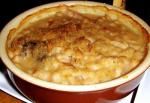
Cassoulet is a rich, slow-cooked bean casserole originating in the southwest of France, containing meat (typically pork sausages, pork, goose, duck and
-
Blanquette de Veau
Feb 22, 17 05:24 AM
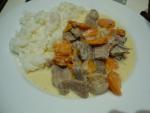
Blanquette de Veau or veal stew is one of the most famous dishes of French cuisine. Normally prepared with veal but there are many variants with lamb,
-
French Fish Recipes
Feb 05, 17 02:46 PM

French fish recipes are in abundance all around France, they love seafood dishes, any type of fish will do! they're not fussy.
Submit a Recipe
Do you have a great French Recipe? Then why not share it with us.
Add your Restaurant Here
Submit your restaurant listing to be added to the French Food Directory.
Featured Restaurant
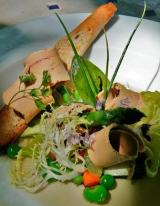
This is a very famous French restaurant in Tremolat, I have eaten here several times, as I was lucky enough to live practically next door. Its a unique location where you can relax with nature or share a michelin quality meal with friends or family.